
HYROX’s final station is 100 wall-ball shots – a deep squat and medicine-ball throw repeated 100 times – after 8 kilometers of running and seven other workouts. In open divisions, athletes (men and women) throw a 6 kg (men) or 4 kg (women) ball at a 3 m (men) or 2.7 m (women) target for 100 reps. By this point every muscle is fatigued, so efficient technique, consistent pacing and mental grit are crucial. In this guide, we break down the wall-ball movement, pacing strategy, biomechanics (especially hip/ankle mobility), mental factors, common mistakes, and a sample 3–4‑week training progression.
Understanding the HYROX Wall-Ball Station
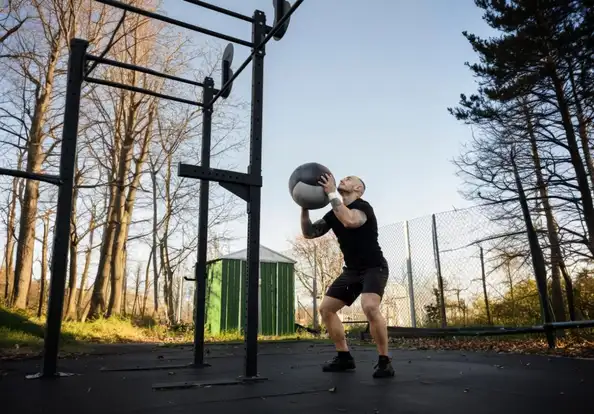
In HYROX, 100 unbroken wall balls means performing 100 perfect wall-ball reps in a row without pausing. Each rep begins standing tall (hips and knees extended), then you descend into a full squat (hips below parallel), and as you stand, you launch the ball upward to hit the target. The ball is caught on the rebound and the cycle repeats. Men’s open athletes use a 6 kg ball (to a 3.0 m target); women’s open use 4 kg (to 2.7 m). (Pro athletes throw heavier balls – 9 kg for men, 6 kg for women – but the technique is the same.)
Because wall balls come last, they are a brutal test of full-body fatigue and coordination. Your legs are “cooked” from lunges and sleds, and your heart rate is through the roof. A strong finish on wall balls requires not just leg and shoulder endurance, but also cardiovascular stamina and focus. Each rep must hit the target cleanly from the correct height – judges call “no rep” (and add time/fatigue) if your hips weren’t below parallel on the squat or if the ball misses the center of the target. So you must balance power (to hit the target) with precision and endurance over 100 reps.
- Station order: Wall balls are always the last of the eight HYROX stations, after 8 km of running plus burpees, rowing, lunges, etc. Expect your quads and shoulders to be heavily fatigued.
- Reps/Load: 100 total reps (Women open: 4 kg; Men open: 6 kg). Target height: 2.7 m for women, 3.0 m for men.
- Movement: Start from standing, squat until hip crease is below knee level, then stand and throw the ball to the target. Catch the rebound and immediately squat again.
- No-Rep Penalties: Any rep with hips above parallel, or with the ball missing the center of target, or catching it irregularly, will be no-repped. Consistent depth and accuracy are mandatory.
An effective wall-ball strategy hinges on efficient, rhythmic reps. Smooth pacing and precise form allow you to complete large sets without dying. Planning in advance – for example deciding a rep split or breathing pattern – will help conserve energy for all 100 reps.
Cadence, Pacing and Energy Management
Maintaining a steady cadence is key. Chase a sustainable rhythm rather than blasting out a few quick reps and then burning out. Keep pauses to a minimum – treat the rebound like part of the movement, not a full stop. One technique is to catch-and-squat: as the ball comes down, immediately descend into your next squat, so the motion flows. This smooth cycle “helps you maintain rhythm and avoid wasting time or energy between reps”.
- Steady rhythm: Aim for consistent rep timing. A smooth, unbroken pace avoids spikes in effort. For example, breaking the 100 reps into manageable chunks (e.g. 5×15 with short rests, or EMOM sets) so that you practice a uniform rhythm. During the effort, exhale as you press/throw the ball and inhale as you descend. In practice breathe out on the upward throw and inhale on the squat. This controlled breathing (inhale in, exhale out) keeps your heart rate from spiking too fast and supplies fresh oxygen to the legs.
- Minimal pause: Avoid stopping at the bottom. The squat rebound should naturally pop you back up. We recommend letting your body “rebound you out of the bottom,” using elastic stretch reflex, rather than forcing a pause at parallel. In other words, give full squat depth but don’t hold it – bounce slightly out of the hole to reduce energy cost.
- Pacing / breaks: Even if you aim for “unbroken,” it can help to mentally divide the work. Common splits include sets of 25–20–15–10–5 or 4×25, etc. Some elite coaches suggest planning short rests (3–5 seconds) after each sub-set to “maintain technique and manage lactate buildup”. It’s important not blowing all-out early: if doing 40 fast reps exhausts you, it may be better to do sets of ~15 with brief rests. The goal is to “finish strongly” – often that means holding back a little early so you can sprint the last reps.
- Mental rhythm: In the chaos of race day, focus on your breathing and motion. Tune out distractions – other athletes, announcements or fans – and keep your eyes on the target. A consistent count or mantras (e.g. “breathe-squat” each rep) can reinforce a calm, steady cadence.
By controlling cadence, you spread effort evenly. This energy management prevents early lactate accumulation and lets your legs recover slightly between reps. In short, treat wall balls like an 8–10 minute aerobic effort rather than a sprint: pace it.
Biomechanics and Mobility
Squat Mechanics
Wall balls are essentially a repetitive squat-thrust with a medicine ball. Proper squat form is critical for efficiency and to avoid no-reps. Every rep should start from standing tall (hips/knees locked) and go to a full squat (hips below parallel). Judges will check that your hip crease passes below the knee joint. To achieve this, you need adequate hip and ankle mobility, as well as core stability to hold posture.
- Hip and ankle mobility: Research shows that squatting below parallel typically requires about 120° hip flexion and 15–20° ankle dorsiflexion. If your hips or calves are too tight, you may not reach depth without compensation. For example, if ankles lack flexion, many lifters rotate their feet outward to squat deeper – but this alters knee tracking and can waste energy or risk injury. Work on ankle stretches and hip openers (like deep lunges, squat holds, foam rolling) so you can comfortably hit depth. In a pinch, HYROX judges will provide a box to guide depth, but it’s better to train without it.
- Stance: A common recommendation is feet slightly wider than hip-width, toes pointed out ~15°. Find a stance where you can consistently reach full depth with good balance. A wider stance often lets you squat deeper comfortably. Keep weight on mid-foot/heels, chest up, and spine neutral (no rounding or hyperextension). This upright torso maximizes leg drive and protects the lower back.
- Joint coordination: In the squat, ankles, knees and hips should move together. As you descend, the shins and torso angles should remain roughly parallel (to avoid over-bending at the waist). Drive the knees out (track over toes) to create space for the hips, and push the glutes back (as if sitting in a chair). On the way up, push through the heels, extend hips and knees forcefully, and use that full leg drive to throw the ball. Effective wall-ball form is essentially a “triple extension” (ankles, knees, hips all extending) powering the throw.
In summary, work on squat mobility drills so that you hit hip crease below knees every rep. A study notes that good mobility at each joint is needed for efficient transfer of force in a squat. Limited range anywhere (e.g. tight ankles) forces compensations (foot rotation or torso lean) that make reps harder. Practice weighted squats, lunges, and goblet squats to build the specific flexibility and strength to maintain perfect depth even under fatigue.
Power Transfer and Movement Economy
Because the wall ball is a cyclic, high-volume movement, economy of motion is key. You want to minimize wasted energy each rep:
- Drive from the legs: Your legs and hips are far stronger than your shoulders. Propel the ball mostly with leg extension, using the arms only to guide and aim. Think about jumping the ball: squat deep, then explosively “jump” with legs to full extension, and only at full extension throw with arms.
- Ball position and catch: Keep the ball close (chin or sternum level) to maintain an upright chest. After throwing, relax your arms while the ball is in flight (don’t hold tension overhead) and lower them quickly to catch. Catching the ball at mid-chest, rather than overhead, lets you immediately drop into the next squat. In fact, try to catch on the descent: meet the falling ball with bent legs as you squat down, then bounce up. This “catch-squat” fluidity uses the ball’s momentum and elastic rebound to reset quickly.
Good wall-ball mechanics mean each rep feels almost like a fluid cycle rather than separate movements. The less you pause or deviate (no big flares of the elbows, no bouncing up too early), the less energy each rep costs. Even under exhaustion, maintaining an efficient, stable technique minimizes “leaks” of energy.
The Psychology of 100 Unbroken Reps
Beyond the body, completing 100 wall balls unbroken is as much a mental challenge as a physical one. It’s normal to feel a wave of dread arriving at this station – your brain is tired and adrenaline is high. You must dig deep mentally to push through:
- Mindset: Treat it like the final climb of a race. Remember that pain and heavy legs are unavoidable – focus on form and small goals. For example, mentally tackle five reps or ten reps at a time. Markers on the rep counter (often visible at HYROX) can help you pace mentally (e.g. aim to reach 50 reps without stopping).
- Stay Present: Anxiety or overthinking (“how many do I have left?”) can break rhythm. Instead, concentrate on the process of each rep: breathe, squat, throw, catch. Some athletes find cues (e.g. sync breathing with “up/down” commands) helpful. One HYROX coach advises ignoring the chaos – crowds, noise and fatigue – and “stay focused on your movement”.
- Positive Self-talk: Reinforce confidence by recalling training. Remind yourself: “I trained for this” or “I’ve done 150 in practice.” Visualization can work too: before your attempt, picture yourself moving smoothly through the last 10 reps, staying composed. When fatigue hits, use short mantras (“One more rep,” “Strong, steady”) to push each rep.
- Break Strategy: Even aiming for unbroken, many athletes still plan mini-breaks if needed. For example, breaking into sets of 20–15–15–10–10, with a very brief 3-second pause between, can feel more manageable. The knowledge that you have a quick rest coming can ease anxiety and keep your mind relaxed.
- Embrace the Grind: Finally, see it as a badge of endurance. Completing 100 wall balls unbroken is often described as a mark of stamina and mental toughness. As one HYROX community source says, doing so “signals a level of strength, endurance and mental toughness” (Red Bull) and is “the ultimate test of full-body fatigue”. Cultivate the resolve that this is your finisher – dig into discomfort and trust your preparation.
By adopting a strategic mindset (controlled breathing, chunking reps, positive cues) you can push past the urge to quit. Remember that every rep you complete under stress builds mental resilience.
Common Mistakes and Inefficiencies
Even strong athletes can fall into bad habits when fatigued. Here are frequent wall-ball pitfalls and how to fix them:
- Standing too close to the wall: If you plant your feet right under the target, the ball bounces back almost immediately and disrupts timing. Fix: Stand about one foot behind the ball. This extra space lets the ball arc and fall without throwing off your rhythm, giving you a brief natural “reset” into the squat.
- Catching the ball too high (upright): Many people catch at full height, forcing them to do a weighted squat every rep. This wastes leg energy. Fix: Catch the ball on the way down, just above chest level. In other words, as you come out of the catch, immediately squat down. This lets you bounce out of the bottom (using momentum) instead of starting each rep from standing.
- Too much arm work: If you rely on your shoulders to throw the ball, you’ll burn out quickly. Fix: Keep arms mostly relaxed; use them only to guide the ball up after leg drive. Focus on generating power with the legs at each ascent. Think “legs do the pushing, arms just hold on.”
- Shallow squats (no-reps): Failing to descend fully is an instant time penalty. Fix: Practice mobility and cue yourself to hit deep. You should see your hip crease below your knee on each rep. If flexibility is an issue, use assisted deep squat drills or even request a box at the event until you can drop low unassisted.
- Holding breath or bracing: Some athletes brace too rigidly and hold their breath, which spikes heart rate. Remember to breathe rhythmically (exhale on the throw, inhale in the squat). Controlled breathing helps calm the mind and muscles.
- Unplanned pacing (ego starts): Going too hard too early (e.g. 30+ fast reps) often means total burnout. Instead, start at a steady pace or even slightly conservative. As RoxLyfe notes, many people “make the mistake of doing as many as they can at the start, but end up exhausted”. Plan your strategy in training so on race day you know your limits.
Correcting these errors – staying the right distance from the target, keeping a low catch, using legs, and squatting to depth – will make each rep more efficient. This economy of movement is essential to string together 100 reps without breaking.
Training Progressions for 100 Unbroken Reps
Building the capacity to do 100 wall balls unbroken takes structured training. Here is an example 3–4 week progression geared to intermediate/advanced HYROX athletes. Adjust loads to your category (eg. men’s open RX 6 kg; women’s open RX 4 kg).
- Week 1 (Technique & Volume Base): Focus on perfect form and building volume. Example: 5×10 reps at controlled pace with 1–2 min rest. Use your race weight (women: 4 kg, men: 6 kg) or slightly heavirer (e.g. 6–8 kg for men; 4–6 kg for women) to groove mechanics. Practice breathing and catching low each rep. You might do these on 2–3 non-consecutive days (total ~200–300 reps this week). Also include general conditioning (runs, row) beforehand to mimic fatigue.
- Week 2 (Increase Sets/Reps): Build towards larger sets. For example: 4×15 reps @RX weight, with ~90 sec rest. Alternatively do 3×20 with 2 min rest, or a 3-minute continuous set (AMRAP) seeing how many reps you get. Still emphasize form and breathing. Total weekly volume ~250–300 reps. If possible, train wall balls under fatigue at least once (e.g. a short run before your wall-ball sets).
- Week 3 (Volume & Intensity): Push volume higher and simulate race pace. Try 3×25–30 @ race weight, resting 2–3 min. If unbroken is too hard, take 5–10 sec breaks as needed but aim for minimal pause. Alternatively, do interval-style sets: e.g. EMOM 12 reps for 8 min, or Tabata intervals of wall balls. This week you can mix in one session with a heavier ball (e.g. +20% weight) for low reps: e.g. 5 sets of 8 reps at 120% load. This builds strength so your RX weight feels lighter. Total volume can be ~300–350 reps.
- Week 4 (Race Prep): Taper a bit and practice pacing strategy. One workout: 100 wall balls for time with planned breaks (for example, 25-15-10-10-10-10-10-10 with 3‑5 sec rest between sets). Another session: 3×20–25 with 2-min rest, focusing on perfect unbroken form. By now you should hit near-race pace on unbroken subsets of 20–30. If the race is imminent, switch back to 100% race weight and only use heavier balls for brief warm-up rounds (no heavy loading days).
Progressive Overload: Gradually raise weekly total volume by ~10% per week, then deload (e.g. 250 reps → 275 reps → 300 reps → 250 reps). This builds both muscular endurance (slow-twitch fibers) and aerobic fitness. Note that high-rep training (e.g. 20–28 reps per set) boosts muscular stamina and aerobic capacity. Meanwhile, include 1–2 weekly short aerobic or CrossFit workouts (runs, assault bike, rowing) to improve overall endurance.
Sample Session (Week 3): Warm up with dynamic hip/ankle stretches. Then 4×20 wall balls (6 kg men/4 kg women) @ moderate pace, 1.5 min rest. Follow with 4×10 wall balls @ 120% weight (e.g. 8 kg/6 kg), 90 sec rest. Cool down and stretch quads.
Throughout training, monitor form. If depth or posture crumbles in later reps, reduce reps per set and build back up. As fitness grows, gradually reduce rest between sets or increase reps per set. The goal is that by week 4 you can perform 40–50 unbroken with the race weight – making the leap to 100 achievable with splits or (ideally) fully unbroken if you’re very advanced.
Scientific Foundations: Endurance, Aerobic Capacity and Economy
HYROX wall balls demand a mix of muscular endurance and aerobic stamina. It’s not just brute strength – your ability to sustain forceful squats over minutes is what matters. In sports science terms, wall balls train the same “endurance” that keeps muscles firing under fatigue. For example, lifting moderate weight at high reps (12–20+) develops slow-twitch muscle fibers and capillary networks, so muscles resist fatigue better.
Moreover, HYROX is partly aerobic. Your heart and lungs must deliver oxygen to working muscles even late in the race. A solid aerobic base (zone-2 training, long intervals) helps clear lactate and delay fatigue during the continuous effort. One HYROX guide emphasizes that wall balls “tax your muscular endurance… and aerobic capacity”. In other words, wall balls become partly a cardio exercise when done for minutes on end.
Pacing and Fatigue Resistance: Strategically splitting reps is a form of pacing. In any long effort, an even pace conserves energy and delays burnout. Pacing theory (used in marathon running and CrossFit alike) says avoiding an early surge and keeping effort steady will yield a faster finish time. Importantly, improving fatigue resistance – the ability to maintain power as lactic acid builds – is central. A sports coach notes that “the goal of any endurance athlete is to improve fatigue resistance”. That means training muscles to keep contracting strongly under load (exactly what high-rep wall-ball training does).
Finally, movement economy is science-speak for performing a task using less energy. Every efficiency trick (keeping core stable, minimizing arm work, smooth breath) reduces the oxygen demand of each rep. Small technical tweaks therefore pay big dividends at rep 100. In short, a well-conditioned HYROX athlete combines (1) muscular endurance (via high-rep strength work), (2) aerobic capacity (via cardio training), and (3) efficient pacing/technique to maximize economy.
Ready to crush your wall-ball training? Roxzone offers HYROX-specific training plans and coaching tips (see Training Plans on our site) to help you build power and endurance for every station. Check out our plans and workouts to tackle 100 wall balls with confidence.
Disclaimer: Roxzone is an independent training provider and not an official HYROX partner. Our advice is based on research and experience, but always follow official HYROX rules and use your best judgment in training.