

HYROX training programming is not about training harder, but about structuring stress, recovery, and progression so performance improves over time. Training hard is easy; training well is hard. In HYROX—an ultra-demanding hybrid event of repeated runs and intense functional stations—athletes often push themselves to the limit, yet many plateau or burn out because the plan lacked structure. In fact, research shows that over 50% of exercisers quit within 6 months due to “failure, lack of improvement, or changes in motivation”. In other words, most HYROX failures aren’t due to laziness but to unsustainable programs. Well-designed programming ensures every hard session contributes to long-term gains. This article explains why structured planning (not just maximal effort) is key to consistent progress, and how to implement it effectively.

What “Training Programming” Really Means in HYROX
“Programming” is more than a single workout or even a week of training. Periodization is an overarching plan divided into phases, while programming is the precise manipulation of training variables within those phases. In practice:
- Isolated training: A one-off session with no connection to other workouts. It produces only transient effects.
- Weekly plan (microcycle): A schedule of sessions for one week – better than random workouts, but still short-sighted.
- Full programming (macro/meso/microcycles): A multi-week or multi-month plan where macrocycles (e.g. a season or year) break into mesocycles (3–4 month blocks) and microcycles (1–4 week blocks). Each phase has specific goals (e.g. base fitness, strength, taper) and builds on the last.
Effective programming manages all training variables simultaneously: volume (how much work), intensity (how hard), frequency (how often), recovery (rest and regeneration) and specificity (alignment with HYROX demands). For example, strength volume and running mileage might rise and fall over weeks, while intensity spikes are timed around taper. Keeping these in balance ensures steady adaptation and avoids “accumulated fatigue” that hinders progress. In practice, HYROX training programming goes far beyond isolated workouts.
Why Consistency Is the Greatest Predictor of Performance
- Consistency vs. Occasional Peaks: Sporadic high-intensity or high-volume spikes feel productive, but without consistency they lead to overreach and injury. Regular training with moderate but accumulating stress yields far better results. As one review noted, “structured training planning, appropriate workload distribution, and tailored recovery strategies are crucial to maximising performance while preserving athlete safety”. In contrast, unrealistic surges in training often backfire.
- Adherence Breeds Progress: Adhering to a plan (even a tough one) predicts success. In a triathlon study, adherence was highest in athletes following structured periodized plans; by contrast, “free” (unstructured) training led to many dropouts. Crucially, if motivation or structure is lost, “compromising the accumulative effect of workloads will diminish the chronic effects of the periodization plan, leading to failure and lack of improvements”. In practice, athletes who stick with a well-balanced plan see steady gains; those who go all-out only some days burn out or stagnate.
- Why Too-Aggressive Programs Fail: When training load exceeds recovery capacity, performance suffers. The classic fatigue-fitness model shows that if stress continues past what the body can adapt to, exhaustion and staleness occur. For example, pushing volume and intensity too high for too long without deloading creates “supercompensation” only briefly before collapse. A periodized plan prevents this by intentionally cycling stress and rest, allowing fitness to build more sustainably.
Consistency is the foundation of effective HYROX training programming.
Progression vs. Intensity: Where Most Athletes Go Wrong
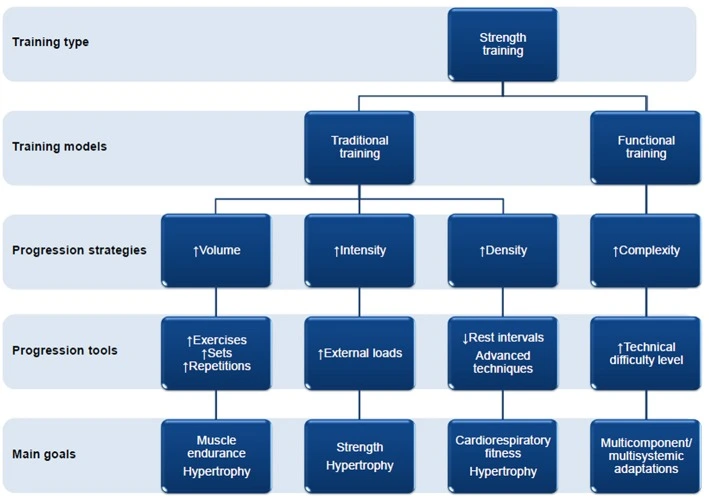
Real progression in hybrid training isn’t just “going harder”; it’s increasing stress in a recoverable way. There are four main ways to progress:
- Increase Volume: More sets, reps, or total workout time. (E.g. adding another set of lunges or lengthening a long run.)
- Increase Intensity: Greater load or speed. (E.g. heavier sled, faster run pace.)
- Increase Density: Do the same work faster (shorter rests) or add intensity techniques. (E.g. reduce rest between stations to raise cardiovascular demand.)
- Increase Complexity: Make movements harder or more technically demanding (more balance, speed, or coordination). For instance, performing exercises on unstable surfaces or adding multi-planar drills increases the stimulus without raising weight.
Many athletes focus only on raw intensity (heavier weights or faster sprints) and neglect other progression modes. This can quickly reach a “peak” that’s hard to recover from. Instead, gradually layering stress – for example by adding reps or shaving seconds off rest while leaving weight moderate – often yields better adaptation with less fatigue. Always ensure the added stress is recoverable: progressive overload should challenge but not overwhelm. As training experts note, without proper variation and recovery, “if load is too high, the physiological costs will be too great and the athlete’s readiness will be compromised”. A common mistake in HYROX training programming is confusing intensity with progression.
How to Adapt Programming to the Athlete’s Real Life
Training exists within life’s context. Work, family, and life stress add “real load” beyond the gym or track. Key considerations:
- Life Stress Adds to Training Stress: A tough week at work or poor sleep raises fatigue. Recognize that your body sums up all stressors (even non-training ones). When life is busy or stressful, it’s wise to reduce intensity or volume slightly rather than push unaltered. For example, include an extra rest day or swap a hard session for active recovery.
- Stay Flexible, Not Random: The plan must allow wiggle room, but still retain structure. In practice, this means adjusting sessions (e.g. moving a workout or changing its intensity) in response to life demands, without abandoning the overall plan. It’s like steering a ship: you may change course a bit each day, but you still aim for the same destination. A rigid plan ignores reality, while a totally random approach loses progress.
- Adjust Without Losing Focus: Use monitoring (heart rate, perceived exertion, training log) to gauge when to back off or push harder. For instance, if you feel unusually worn out, drop the workout to a light recovery session, then return to the plan. Research on hybrid athletes emphasizes that planning recovery strategies and workload distribution is crucial for performance and safety. A good coach or program will regularly tweak the athlete’s microcycle based on feedback, keeping long-term goals intact.
Programming by Season Phases (Overview)
Most successful HYROX training follows classic periodization phases. A typical annual or seasonal plan might include:
- Base (General Preparation): Build a fitness foundation. Focus on high aerobic volume (easy runs, skiing, rowing) and general strength (compound lifts, core stability). Intensity is mostly low (Zone 2 running) with few hard sessions. The goal is to grow “the engine” – cardiovascular capacity and resilient musculature – without undue fatigue.
- Build (Specific Preparation): Shift toward HYROX-specific work. Introduce threshold and tempo runs, longer circuits of stations, and higher-weight strength-endurance exercises (e.g. heavy lunges, sled pushes). Volume remains substantial but intensity climbs (harder runs, heavier loads, or shorter rests). Practice transitions: e.g. running off a sled push into a run. The focus is on bringing the base into form.
- Peak/Specific: Simulate race conditions. Perform full or partial Hyrox workouts (e.g. 4 runs + stations in sequence) under fatigue. Sharpen pace and technique on each station. Training volume tapers, but intensity (race pace efforts) is high. This phase teaches the body to hold target pace and maintain form when exhausted.
- Taper/Polish: In the final 1–2 weeks, reduce volume dramatically (often 40–50%) while keeping intensity up. Light, short sessions and easy runs dominate, allowing supercompensation. The goal is freshness – coming into race day with maximal energy and honed skills.
These phases build on each other. For example, a 16-week HYROX block might spend weeks 1–4 on base (growing aerobic and strength “engines”), weeks 5–10 on building race-specific endurance, weeks 11–14 on peaking with race-pace simulations, and the last 2 weeks on tapering. Each phase has purpose (general conditioning ➜ specificity ➜ race readiness) without excessive detail overload. Well-designed HYROX training programming follows clear seasonal phases.
The Role of Longevity in Hybrid Training
HYROX can be done year after year – it rewards consistent athletes over decades. A long-term view is essential:
- Think Years, Not Just a Season: Sustainable performance beats short bursts. Research on veteran athletes recommends balancing training load with recovery, incorporating strength work to prevent injuries, and avoiding “large training load peaks”. In practice, this means building slowly and respecting deloads. An athlete in their 40s will recover slower than a teenager, so the program should emphasize joint-friendly strength and ample recovery.
- Performance vs. Wear-and-Tear: Chasing every last second in one season can cost years of performance. For example, backing off a bit on load in midsummer may slightly delay improvement but prevent burnout that could end an athlete’s multi-year streak. Studies note that age-related decline is inevitable, but expert coaches can compensate by maximizing experience and technical skill. Emphasizing longevity (through variety, recovery, and smart strength training) often improves current performance because the athlete can train more days without injury.
- Monitoring for Long-Term Health: Use metrics like heart-rate variability, training load scores, or simple wellness scales. Adjust the program if signs of chronic fatigue appear. A recent review advises avoiding training through excessive fatigue and stresses that structured planning includes recovery strategies to preserve health. In short, thinking long-term—about staying healthy for next season—actually leads to better progress this season.
When a Monthly Program Makes Sense
A monthly (or multi-week) training plan is a tool, not a right.
- Who It’s For: Athletes who need external structure—beginners, busy professionals, or anyone whose motivation wanes easily—benefit most. A written monthly program provides accountability and clear goals. Even advanced athletes use block plans to stay on track. Studies show that structured periodized plans greatly improve adherence: triathletes on traditional or reverse periodization stayed in training far longer than those on “free” plans. In fact, most dropouts occur in unstructured programs due to lack of visible progress. If you struggle to keep training consistently, a tailored monthly program ensures you build gradually without guesswork.
- Who It Might Not Fit: Highly experienced competitors or coaches often self-manage periodization, and may prefer flexible “undulating” models that aren’t tied to rigid time blocks. Also, athletes who travel or have unpredictable schedules might need to improvise more. Still, even they often benefit from at least a broad framework (e.g. “this month is base” vs “build”).
- Benefits of a Continuous, Adjustable Structure: A good monthly plan is not locked in stone; it adapts to feedback (e.g. you can swap days or repeat a week if illness hits). Yet it keeps you progressing toward larger goals. Continual structure prevents the “now what?” feeling after each race. It also allows ongoing progress checks: every 4 weeks, you can test and recalibrate. Subtle support is built in: for example, knowing that a recovery week is coming lets you push hard when it’s time.
In short, ongoing programming creates freedom by removing uncertainty. You choose to follow a plan, but then training runs the ship, freeing mental energy for training itself.
Conclusion
Consistent, structured training creates true freedom on race day. By following a well-designed HYROX program—rather than simply trying to “train harder”—athletes of all levels unlock steady improvement and avoid setbacks. Remember: structure builds progress. If you want to apply these principles without managing every detail yourself, a personalized monthly program does exactly that. It delivers a smart plan, adapts to your life, and lets you focus on execution while knowing each workout has a purpose. Train well, train smart, and the results will follow.